A retrospective on Restaurant Brands Asia Ltd. | December 2020 – November 2026
Back in December 2020, when Burger King India (now Restaurant Brands Asia Ltd.) made its stock market debut, there was considerable excitement surrounding the IPO. The brand was popular, the IPO was heavily discussed across financial media, and retail participation reflected the enthusiasm surrounding the listing.
I remember analysing its EOD chart shortly after listing and sharing my concerns within a close investment circle.
My observations were not based on whether people liked Burger King or whether its restaurants would remain popular. I was looking at something far more important from an investor’s perspective: Was the business financially strong enough to justify the excitement surrounding its IPO valuation?
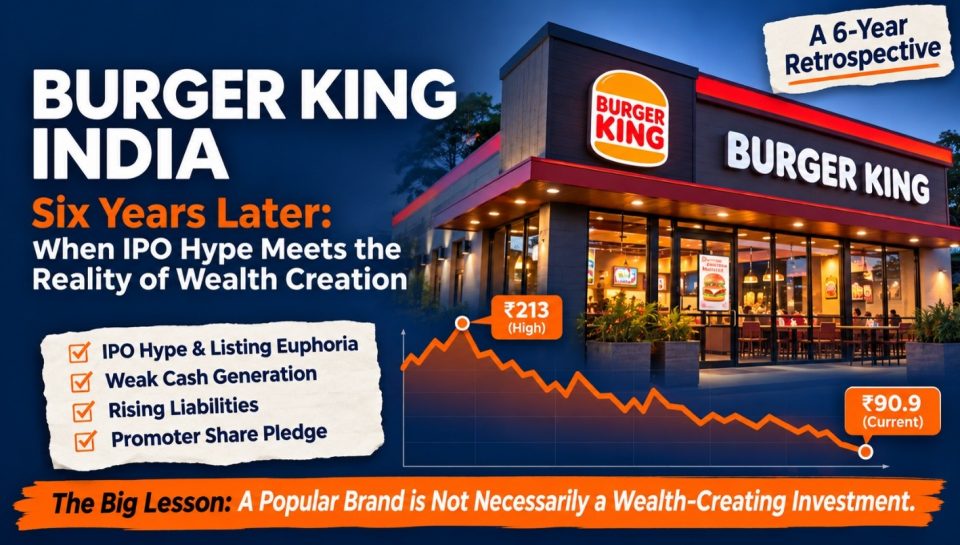
The initial price action did little to inspire confidence. The stock had listed at ₹115 against an issue price of ₹60 and subsequently touched approximately ₹213–215. However, the early technical structure started showing weakness. A bearish engulfing pattern appeared during the initial trading sessions, followed by a gap-down opening. The subsequent recovery attempt failed to regain momentum.
At that point, I had already started questioning whether investors were getting carried away by the IPO narrative.
Six years later: What does the scoreboard say?
Fast forward to November 2026.
The share price is hovering around ₹90–91, considerably below its listing-era highs.
Let us put the numbers into perspective:
- IPO issue price: ₹60
- Listing price: ₹115
- Listing-era high: Approximately ₹213–215
- Current share price: Approximately ₹90.90
An investor who received shares through IPO allotment and held them throughout has technically generated a positive nominal return. However, the annualised return is only around 7% over six years.
For investors who entered around the listing euphoria or closer to the subsequent highs, the experience has been considerably worse.
And this is before accounting for inflation and the opportunity cost of capital.
The important question is not whether the share price is above its IPO issue price. The real question is whether the investment adequately rewarded investors for the risks they undertook.
The financial concerns were visible much earlier
In my original December 2020 commentary, I had highlighted the company’s weak cash-generation profile and increasing liabilities.
The company’s total liabilities had increased from approximately ₹331 crore to ₹922 crore between March 2017 and March 2019.
These were not minor observations. They were signals that deserved deeper investigation before investing.
A popular consumer brand can attract customers, expand its restaurant network and generate impressive revenue growth. But equity investors ultimately participate in the financial performance of the business, not merely its popularity.
Revenue growth without sustainable profitability and cash generation does not necessarily translate into shareholder wealth creation.
The promoter pledge: Another reason for caution
One development that deserves particular attention is the promoter share pledge.
The September 2026 shareholding disclosure indicates that approximately 40% of promoter holdings have been pledged.
This is not something I would ignore.
A promoter pledge is not automatically evidence of wrongdoing or financial distress. However, a substantial pledge, particularly when it appears as a significant change in the shareholding disclosures, warrants investigation.
Investors should ask:
- Why have the promoters pledged such a substantial portion of their holdings?
- Who is the lender?
- What is the purpose of the borrowing?
- What happens if the promoters are unable to meet their obligations?
Promoter shareholding and promoter pledging are two different parameters. Investors should examine both rather than looking at promoter ownership in isolation.
Is the business finally turning around?
Interestingly, the latest Q2 FY27 results offer some encouraging developments.
The company has reported approximately 20% year-on-year consolidated revenue growth. Burger King India’s standalone operations have also reported a profitable quarter, alongside encouraging same-store sales growth.
These developments deserve recognition.
However, there is an important distinction between the standalone Indian business and the consolidated group.
While the Indian operation has shown improvement, the consolidated entity continues to report losses.
The company still needs to demonstrate that its improving operational performance can translate into sustained consolidated profitability, healthy free cash flow and better returns on capital employed.
One good quarter does not establish a sustainable turnaround.
Investors should also remember that an improving business does not automatically make its shares attractive at every valuation.
The bigger lesson: Brand popularity is not investment quality
This is perhaps the most important takeaway from the entire episode.
We often confuse a company’s popularity with its investment potential.
A consumer may love a brand, visit its restaurants regularly and recommend its products to friends. But none of these activities automatically establishes whether the company is generating adequate returns on the capital invested in its business.
Before investing in an IPO, I believe investors should look beyond:
- IPO subscription figures.
- Listing-day gains.
- Television discussions and positive media coverage.
- Brand recognition and marketing campaigns.
- Short-term market sentiment.
Instead, spend time understanding:
- Business economics: Is the company capable of generating sustainable operating profits?
- Cash flows: Is the business generating cash, or constantly consuming it?
- Balance sheet: What is the debt and liability position?
- Capital efficiency: Is the company generating adequate ROCE and ROE?
- Corporate governance: Are promoter actions and disclosures consistent with shareholder interests?
- Valuation: Are you paying a reasonable price for the business’s actual earning capacity?
An excellent business purchased at an unreasonable valuation can still become a poor investment.
Likewise, a popular brand with an expanding footprint may not necessarily become a successful wealth-creation opportunity.
My final thoughts
I never applied for the Burger King IPO, nor have I invested in this company since its listing.
Looking back at my December 2020 observations, I am glad I questioned the excitement rather than allowing the IPO narrative to influence my investment decision.
However, I would not conclude that the company’s future is necessarily bleak. The latest operating improvements indicate that the business is attempting to move in the right direction.
What remains to be seen is whether these improvements translate into consistent profitability, sustainable cash generation and meaningful returns on capital.
For investors, the lesson is straightforward:
Do not invest in a company merely because you recognise its brand. Invest because you understand its business, financial strength, valuation and ability to create shareholder wealth.
Remember, the stock market does not reward popularity. It rewards businesses that create sustainable economic value, provided you buy them at a sensible valuation.
Disclaimer: This article is for educational and informational purposes only and should not be construed as investment advice or a recommendation to buy, sell or hold any security.